


Assessment
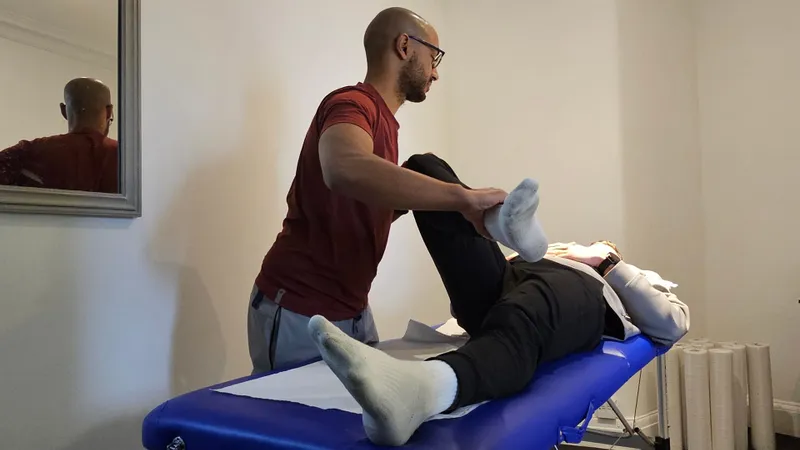
A detailed history, then a thorough examination of movement, strength and the affected area. You leave with a working diagnosis you understand and a plan agreed with you, not handed to you.
The knee is the most-injured region in skiing, with ACL and MCL ligament injuries the classic problem and skier's thumb the most common upper-limb injury. Prepare the legs before you fly and much of it is avoidable, which is why our team readies skiers and snowboarders for the slopes as seriously as we rehabilitate them afterwards.

Overview
Skiing and snowboarding place high, often unpredictable loads on the body, and the injuries are predictable: they happen when the demand of the mountain exceeds what your body is prepared for, most often at the knee or the thumb. They cluster in a few places:
So a lot of our work happens before you travel. A block of pre-ski conditioning builds the leg strength, single-leg control and aerobic capacity that protect the knee and reduce late-day fatigue, when many injuries happen. Prevention beats cure on the slopes, and a sensible preparation block in the weeks before travel makes a real difference.
After an injury, assessment starts with an accurate diagnosis and an honest read on what the tissue is ready to handle. From there, a progressive loading plan rebuilds strength and control, and we judge readiness using criteria-based return-to-sport: restored strength, limb symmetry and confidence under load, rather than discharging on how the knee feels. ACL injuries are managed in partnership with your surgeon where surgery is indicated, with structured post-surgical rehabilitation through each phase.
Excellent
From 6 five-star Google reviews
Source: Google
David helped me when I started to have a strong tibia pain only 5 weeks before the marathon. I genuinely thought at some point that I wasn’t going to be able to do it and I did my PB!
After suffering with terrible back pain, Gus has helped me make huge improvements. Very professional and happy to explain the processes and treatments. Many thanks
Couldn’t recommend this physio team enough! They helped me recover from a knee injury 3 weeks before the London Marathon which I thought was going to prevent me from running it! Everyone was really friendly, supportive and genuinely cared about helping me reach my goal. Special thanks to Charlie, Gus, Brad and Stef!
I came to Dave with an ongoing injury that I’ve been struggling with for months! He helped sort it out straight away, also giving me some exercises to help target the area to get back to full strength. I’m now back to running pain-free already and training properly — I’ll definitely be recommending Kaizen Physiotherapy to my clients!
Gus worked miracles to get me running a marathon after being injured 6 weeks out. He worked out the issue really quickly and provided a clear and actionable plan to deal with it. The sports massages were the best I’ve ever had too — thanks Peggy! Can’t recommend Gus and Peggy enough.
I had such a positive experience working with Brad at Kaizen. He supported me through a meniscus tear and got me all the way back to running a half marathon and HYROX training. Everything was structured, progressive, and easy to follow, and I always felt like I was in safe hands.
Many ski injuries happen late in the day, when tired legs stop protecting the knee. A pre-ski conditioning block in the weeks before travel builds leg strength, single-leg control and the aerobic capacity that keeps your technique honest on the last run.
Knee ligament injuries are the signature skiing problem, typically from a twisting fall or a binding that fails to release. We rebuild stability and strength with staged, criteria-based rehabilitation, whether your knee is managed with surgery or without it.
A fall onto a planted pole sprains the thumb's ulnar collateral ligament, the most common upper-limb ski injury. Our hand therapist provides splinting and graded rehabilitation so the thumb regains the grip strength that poles, luggage and daily life demand.
Snowboarding shifts injuries toward the upper limb, usually from falls onto an outstretched hand. Wrist sprains, fractures in recovery and shoulder injuries are rehabilitated with graded loading, restoring the strength and confidence to fall well and ride again.
A winter injury has months to be rebuilt before the next trip, and we use them. Progressive strength work restores what the injury took and adds the capacity that protects you, judged against objective criteria rather than the booking date.
The Performance MOT is a head-to-toe movement and strength screen with force-plate testing. Before a ski trip it finds the weak links, left-right differences and control gaps most likely to show up on the mountain, while there is still time to fix them.
Why it happens
A twisting fall with the ski or board fixed to the foot, the classic mechanism for ACL and MCL knee injury
Bindings that fail to release, transmitting rotational force through the knee
Falling onto a planted ski pole or an outstretched hand, spraining the thumb, wrist or shoulder
End-of-day fatigue and reduced concentration, when leg strength and control fade and many injuries occur
Going hard on day one without pre-trip conditioning or a graded build-up of slope time
Terrain, speed and conditions beyond current technical ability

Your initial visit runs 45–60 minutes: a detailed history, then a thorough examination of movement, strength and the affected area. We explain what we find in plain English and agree a working diagnosis together.
Treatment starts the same day, and you leave with the first exercises of a plan built around your goal.
Better than yesterday. Kaizen means continuous improvement: small, repeatable gains, built session by session, until you are back to what you love and no longer need us.


Book online through Jane and self-refer, with no GP letter needed. If you are using private health insurance, check your policy first: some insurers ask for a GP referral before your first session.
Everything starts with a proper assessment. We find what is driving the problem, treat it, and build the strength that keeps it fixed, so you finish performing, not just pain-free.
A detailed history, then a thorough examination of movement, strength and the affected area. You leave with a working diagnosis you understand and a plan agreed with you, not handed to you.

Hands-on care to settle symptoms and restore movement: manual therapy, with acupuncture, shockwave or soft-tissue work where they genuinely help. The first home exercises go with you the same day.

Progressive exercise that returns strength, control and load tolerance, from Reformer Pilates to strength and conditioning. Each follow-up reassesses against your baseline, so progress is measured rather than guessed.

Criteria-based milestones return you to work, sport and training. Discharge happens by mutual agreement once you can manage independently, with a Performance MOT available to catch the next weak link early.

Treatment approach
Pre-ski conditioning builds the leg strength, single-leg control and aerobic capacity that protect the knee and reduce the late-day fatigue when many injuries happen. It is the most useful thing a skier can do in the weeks before a trip.
See treatment detail →Sports physiotherapy is the core treatment after a ski injury: accurate diagnosis of the knee, thumb or shoulder, a graded loading plan, and criteria-based return-to-sport rather than discharging on how the joint feels.
See treatment detail →FAQ
Start a conditioning block a few weeks before you travel. The priorities are leg strength, single-leg control and balance, and some aerobic fitness so your legs hold up late in the day when many injuries happen. We tailor a short programme to your fitness and the type of skiing you do, and progress it sensibly in the run-up to departure.
If the knee gave way, swelled quickly or feels unstable, treat it as a potential ligament injury: rest, ice, compress, elevate and avoid loading it hard. Arrange an assessment promptly so we can diagnose the structure involved, distinguish an MCL sprain from an ACL injury, and decide whether imaging or a surgical opinion is needed before rehabilitation begins.
Skier's thumb is a sprain of the ligament on the inner side of the thumb, usually from falling onto a planted pole. Mild sprains settle with splinting and graded loading; a complete tear can need surgical repair to restore pinch grip. We assess the thumb's stability, guide rehabilitation and refer for a surgical opinion when the ligament is fully torn.
Seek urgent help if a joint looks deformed, the knee gives way completely, or you have numbness, tingling or a cold, discoloured limb. Call 999 for these. Contact NHS 111 if you cannot bear weight, swelling or pain is severe, or there is no improvement after a few days of self-care. On-mountain, use the resort medical service first.
Get Started
Kaizen Physiotherapy & Performance • 111 Charing Cross Road, Soho, London WC2H 0DT
BookAppointments typically available within 1–2 weeks