


Assessment
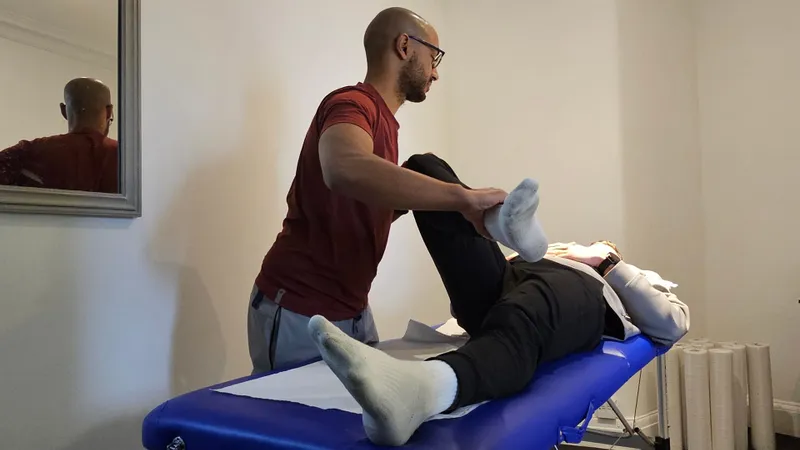
A detailed history, then a thorough examination of movement, strength and the affected area. You leave with a working diagnosis you understand and a plan agreed with you, not handed to you.
Hyrox mixes high-volume running with sled, carry and lifting work, so the shoulder, lower back, knee, Achilles and calf take the load, and most injuries are simply demand outrunning capacity. Our team rebuilds that capacity and manages your training so you reach the start line healthy, not just pain-free.

Overview
Hyrox and functional fitness combine high-volume running with repeated strength stations: sled push and pull, farmer's carries, wall balls, burpees, lunges and rowing. Nearly every injury here tells the same story, more load than the body is ready for: mostly overuse where demand has outrun capacity, alongside the occasional acute strain. The load tends to concentrate in a few places:
We think of it as an injury bucket: capacity on one side, demand on the other, and trouble when demand tips over the top. So assessment starts with an accurate diagnosis and an honest sense of the load the tissue can take today, then a progressive, graded loading plan builds strength, control and work capacity back up, which is to say it builds the bucket bigger. A central part of that is load management: distributing running and strength volume sensibly across a training block and tapering around competition, since training-load spikes are a well-recognised driver of overuse injury.
We judge readiness using criteria-based markers, in line with the BJSM 2016 Bern consensus on return to sport: restored strength, limb symmetry and the ability to handle event-specific demands, rather than discharging on how a niggle feels. Our caseload spans recreational and competitive athletes, and we work around your training calendar rather than against it.
Excellent
From 6 five-star Google reviews
Source: Google
David helped me when I started to have a strong tibia pain only 5 weeks before the marathon. I genuinely thought at some point that I wasn’t going to be able to do it and I did my PB!
After suffering with terrible back pain, Gus has helped me make huge improvements. Very professional and happy to explain the processes and treatments. Many thanks
Couldn’t recommend this physio team enough! They helped me recover from a knee injury 3 weeks before the London Marathon which I thought was going to prevent me from running it! Everyone was really friendly, supportive and genuinely cared about helping me reach my goal. Special thanks to Charlie, Gus, Brad and Stef!
I came to Dave with an ongoing injury that I’ve been struggling with for months! He helped sort it out straight away, also giving me some exercises to help target the area to get back to full strength. I’m now back to running pain-free already and training properly — I’ll definitely be recommending Kaizen Physiotherapy to my clients!
Gus worked miracles to get me running a marathon after being injured 6 weeks out. He worked out the issue really quickly and provided a clear and actionable plan to deal with it. The sports massages were the best I’ve ever had too — thanks Peggy! Can’t recommend Gus and Peggy enough.
I had such a positive experience working with Brad at Kaizen. He supported me through a meniscus tear and got me all the way back to running a half marathon and HYROX training. Everything was structured, progressive, and easy to follow, and I always felt like I was in safe hands.
Hyrox mixes high-volume running with sleds, carries, wall balls and lunges, so most injuries are overload problems with a training story behind them. We identify which station or volume spike drove yours before we change anything about your programme.
The running and sled work concentrate load in the Achilles, calf and knee. Progressive loading rebuilds each tissue's capacity while we manage your running volume, so recovery happens without losing the engine you have spent a block building.
Carries, wall balls and overhead work load the shoulder; hinging, lunging and lifting load the lower back. Graded strengthening restores tolerance in both, with technique and volume adjusted so the fix holds when the stations return.
Training-load spikes are a well-recognised driver of overuse injury. We help distribute running and strength volume sensibly across a block and taper properly around competition, because the fittest athlete on the start line is the one who arrived healthy.
Strength and conditioning bridges rehabilitation and performance, returning the capacity that protects you under race conditions: loaded carries, repeated efforts and fatigue. Each stage is measured against your baseline, so you know the numbers are back before the intensity is.
Criteria-based markers, in line with the BJSM Bern consensus, judge when full training returns. A Performance MOT screen can then find the next weak link before it interrupts a build, keeping the gap between races a training block rather than a rehab one.
Why it happens
Cumulative overuse, where running and strength volume rises faster than the tissue can adapt
Repetitive sled, carry and lunge loads stressing the knee, calf and Achilles
Overhead and wall-ball volume loading the shoulder and rotator cuff
Hinging, lifting and high-rep work loading the lower back, especially under fatigue
Training-load spikes in the build-up to an event without a planned taper
Returning to full training too soon after a previous niggle, leaving residual weakness or altered movement

Your initial visit runs 45–60 minutes: a detailed history, then a thorough examination of movement, strength and the affected area. We explain what we find in plain English and agree a working diagnosis together.
Treatment starts the same day, and you leave with the first exercises of a plan built around your goal.
Better than yesterday. Kaizen means continuous improvement: small, repeatable gains, built session by session, until you are back to what you love and no longer need us.


Book online through Jane and self-refer, with no GP letter needed. If you are using private health insurance, check your policy first: some insurers ask for a GP referral before your first session.
Everything starts with a proper assessment. We find what is driving the problem, treat it, and build the strength that keeps it fixed, so you finish performing, not just pain-free.
A detailed history, then a thorough examination of movement, strength and the affected area. You leave with a working diagnosis you understand and a plan agreed with you, not handed to you.

Hands-on care to settle symptoms and restore movement: manual therapy, with acupuncture, shockwave or soft-tissue work where they genuinely help. The first home exercises go with you the same day.

Progressive exercise that returns strength, control and load tolerance, from Reformer Pilates to strength and conditioning. Each follow-up reassesses against your baseline, so progress is measured rather than guessed.

Criteria-based milestones return you to work, sport and training. Discharge happens by mutual agreement once you can manage independently, with a Performance MOT available to catch the next weak link early.

Treatment approach
Sports physiotherapy is the core treatment for almost every Hyrox and functional fitness injury: accurate diagnosis, graded loading and a return-to-training plan judged against criteria-based markers rather than how a niggle feels.
See treatment detail →Structured strength and conditioning rebuilds the calf, posterior-chain, shoulder and trunk capacity these events demand, and sensible load management across a training block is the best-evidenced defence against the overuse injuries that dominate functional fitness.
See treatment detail →A performance MOT screen profiles strength, mobility and movement before a training block or event, flagging the deficits and asymmetries that drive injury so they can be addressed proactively rather than rehabbed after a breakdown.
See treatment detail →FAQ
Rarely. Most functional fitness injuries are load-related, and modified training that loads the tissue safely supports recovery better than full rest. We usually adjust volume, swap aggravating stations and keep you moving while a specific structure settles, then build load back up. Your physiotherapist will tell you what to modify, pause or safely continue.
We plan load across your block so running and strength volume rises gradually, then taper into the event, because training-load spikes are a well-recognised driver of overuse injury. If you are carrying a niggle we stage which stations to reintroduce and when, aiming to get you to the start line healthy rather than simply pain-free.
Load-related Achilles and calf pain usually responds well to a graded strengthening programme rather than rest. We confirm the diagnosis, settle the early irritation, then progressively reload the tendon and calf complex to rebuild capacity for running and sled work. Persistent or sharp calf pain with swelling should be assessed promptly to rule out other causes.
Seek urgent help if a joint looks deformed, you heard a sudden snap with an inability to push off or bear weight, you have calf swelling with redness or breathlessness, or there is numbness or a cold, pale limb. Call 999 for these. Contact NHS 111 for severe pain or swelling that does not settle with a few days of self-care.
Get Started
Kaizen Physiotherapy & Performance • 111 Charing Cross Road, Soho, London WC2H 0DT
BookAppointments typically available within 1–2 weeks