

Assessment
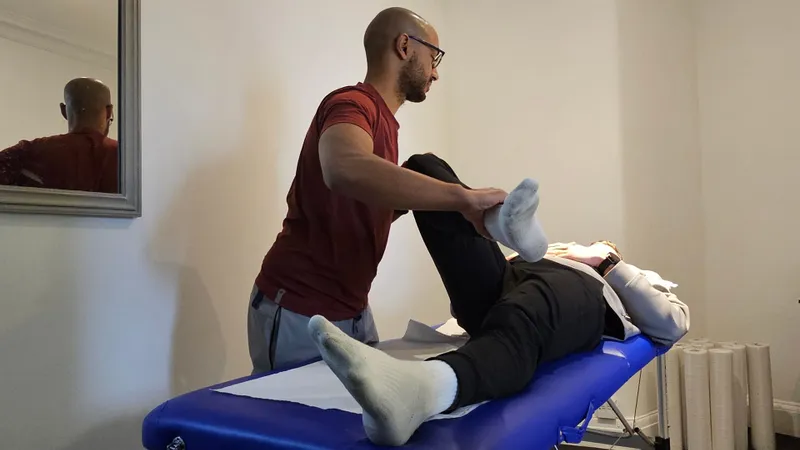
A detailed history, then a thorough examination of movement, strength and the affected area. You leave with a working diagnosis you understand and a plan agreed with you, not handed to you.
Surgery repairs the structure; rehabilitation rebuilds the capacity around it, and how well you come back depends on the weeks and months that follow. We run staged, criteria-based rehab after ACL reconstruction and other knee, shoulder and hip surgery, always to your surgeon's plan and to the elite-sport standards our clinical lead brought from professional football.

Overview
Surgery repairs the structure. Rehabilitation restores the function. How well you recover after an operation depends heavily on what happens in the weeks and months that follow, where a well-structured, progressive plan rebuilds the strength and capacity lost around the joint. ACL reconstruction is the area Kaizen is best known for, but the same principles apply across other surgery:
We always work within the parameters your surgeon or consultant sets, respecting tissue-healing timeframes and any movement or weight-bearing restrictions, then build a staged, criteria-based plan on top. Early stages settle swelling, restore range of movement and reactivate muscle; middle stages rebuild strength, control and capacity; later stages restore power, agility and the sport-specific demands you are returning to.
You progress between stages on objective criteria: restored range, strength, limb symmetry and movement quality, rather than on time alone, in line with the BJSM consensus on return to sport. For ACL reconstruction in particular, returning before those milestones are met is a well-recognised driver of re-injury, so we hold the line on readiness. We coordinate with your surgical team, keep you informed at every stage, and set honest, individual timelines.
Excellent
From 6 five-star Google reviews
Source: Google
David helped me when I started to have a strong tibia pain only 5 weeks before the marathon. I genuinely thought at some point that I wasn’t going to be able to do it and I did my PB!
After suffering with terrible back pain, Gus has helped me make huge improvements. Very professional and happy to explain the processes and treatments. Many thanks
Couldn’t recommend this physio team enough! They helped me recover from a knee injury 3 weeks before the London Marathon which I thought was going to prevent me from running it! Everyone was really friendly, supportive and genuinely cared about helping me reach my goal. Special thanks to Charlie, Gus, Brad and Stef!
I came to Dave with an ongoing injury that I’ve been struggling with for months! He helped sort it out straight away, also giving me some exercises to help target the area to get back to full strength. I’m now back to running pain-free already and training properly — I’ll definitely be recommending Kaizen Physiotherapy to my clients!
Gus worked miracles to get me running a marathon after being injured 6 weeks out. He worked out the issue really quickly and provided a clear and actionable plan to deal with it. The sports massages were the best I’ve ever had too — thanks Peggy! Can’t recommend Gus and Peggy enough.
I had such a positive experience working with Brad at Kaizen. He supported me through a meniscus tear and got me all the way back to running a half marathon and HYROX training. Everything was structured, progressive, and easy to follow, and I always felt like I was in safe hands.
We always work within the parameters your surgeon or consultant sets, respecting tissue-healing timeframes and any movement or weight-bearing restrictions. The staged plan we build on top is explained to you in full, so everyone involved is working from the same page.
The first weeks focus on controlling swelling, restoring range of movement and reactivating muscle that switches off after an operation. Small, consistent wins here make every later stage easier, which is why we start carefully and measure everything.
Middle-stage rehabilitation rebuilds strength, control and capacity with progressive loading matched to how the repair is healing. Each follow-up reassesses against your baseline, and you move forward when the criteria are met rather than when the calendar says so.
Later stages return power, agility and sport-specific function: jumping, landing, cutting and contact where your sport demands it. This is where ACL rehabilitation is won, and it is the part of recovery most often cut short.
ACL reconstruction is the rehabilitation Kaizen is best known for, and the BJSM Bern consensus guides every return: restored strength, limb symmetry and sport-specific function before full training. Returning early is a well-recognised driver of re-rupture, so milestones are non-negotiable.
You see the same physiotherapist throughout, and we communicate with your surgeon and consultant as the plan progresses. Specialist hand therapy covers post-operative hand and wrist recovery, so the same staged, criteria-based approach runs across every operation we rehabilitate.
Why it happens
ACL reconstruction, where graft healing and progressive loading determine strength, stability and the safety of returning to pivoting sport
Other knee surgery (meniscal repair or trim, cartilage procedures), each with its own healing timeframe and loading restrictions
Shoulder surgery such as rotator-cuff repair or stabilisation, where early range and staged strengthening protect the repair
Hip surgery including arthroscopy, labral repair and joint replacement, requiring graded restoration of strength and movement
Post-operative deconditioning: muscle wasting, lost range and reduced confidence that build up around the operated joint
Returning to sport, work or training before strength, control and limb symmetry have been objectively restored

Your initial visit runs 45–60 minutes: a detailed history, then a thorough examination of movement, strength and the affected area. We explain what we find in plain English and agree a working diagnosis together.
Treatment starts the same day, and you leave with the first exercises of a plan built around your goal.
Better than yesterday. Kaizen means continuous improvement: small, repeatable gains, built session by session, until you are back to what you love and no longer need us.


Book online through Jane and self-refer, with no GP letter needed. If you are using private health insurance, check your policy first: some insurers ask for a GP referral before your first session.
Everything starts with a proper assessment. We find what is driving the problem, treat it, and build the strength that keeps it fixed, so you finish performing, not just pain-free.
A detailed history, then a thorough examination of movement, strength and the affected area. You leave with a working diagnosis you understand and a plan agreed with you, not handed to you.

Hands-on care to settle symptoms and restore movement: manual therapy, with acupuncture, shockwave or soft-tissue work where they genuinely help. The first home exercises go with you the same day.

Progressive exercise that returns strength, control and load tolerance, from Reformer Pilates to strength and conditioning. Each follow-up reassesses against your baseline, so progress is measured rather than guessed.

Criteria-based milestones return you to work, sport and training. Discharge happens by mutual agreement once you can manage independently, with a Performance MOT available to catch the next weak link early.

Treatment approach
Sports physiotherapy delivers the staged, criteria-based plan at the heart of post-surgical recovery. It restores range, strength and control, then progresses to power and sport-specific demands, with readiness judged against objective markers rather than time, in line with the BJSM return-to-sport consensus.
See treatment detail →Structured strength and conditioning rebuilds the muscle, capacity and limb symmetry lost around an operated joint. The middle and later stages of ACL, knee, shoulder and hip rehabilitation depend on progressive loading to restore robust, confident function.
See treatment detail →Hands-on physiotherapy supports the early stages, settling swelling, restoring movement and reactivating muscle within the parameters your surgeon sets. It also addresses the everyday function and confidence needed before sport-specific work begins.
See treatment detail →FAQ
It depends on the operation and your surgeon's plan. For many procedures, guided rehabilitation begins within days to restore gentle movement and reactivate muscle, while always respecting tissue-healing timeframes and any restrictions your surgeon has set. We coordinate with your surgical team so your rehabilitation starts at the right time and follows their post-operative guidance.
ACL rehabilitation is a staged process that typically spans many months, and a confident return to pivoting sport often takes around nine to twelve months or more. We progress you between stages on objective criteria, such as restored strength, limb symmetry and movement quality, rather than on time alone. We set an honest, individual timeline at your first session and update it at each reassessment.
Yes. We always rehabilitate within the parameters your surgeon or consultant sets, respecting healing timeframes and any movement or weight-bearing restrictions. Where helpful, we communicate with your surgical team about your progress and milestones. If your symptoms suggest something needs review, we will say so and direct you back to your consultant promptly.
We use criteria-based progression, in line with the BJSM consensus on return to sport, rather than discharging on time elapsed or how the joint feels. That means restored range, good strength and limb symmetry, sound movement control, and the ability to handle sport-specific demands without symptoms. Skipping these stages is a well-recognised driver of re-injury, so we hold the line.
Get Started
Kaizen Physiotherapy & Performance • 111 Charing Cross Road, Soho, London WC2H 0DT
BookAppointments typically available within 1–2 weeks