


Assessment
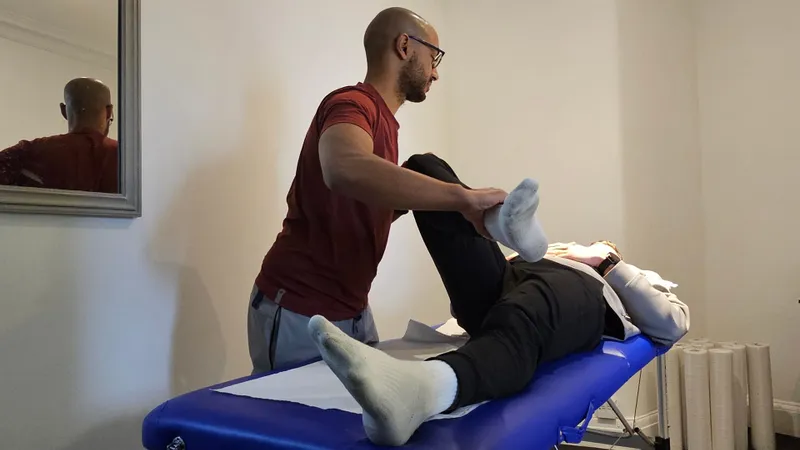
A detailed history, then a thorough examination of movement, strength and the affected area. You leave with a working diagnosis you understand and a plan agreed with you, not handed to you.
Every running stride drives several times your body weight through the foot and ankle, so when training load outruns what the tissue can take, ankle sprains, Achilles tendinopathy, plantar fasciitis, bone stress and recurrent instability follow. We diagnose the load behind the pain, then rebuild calf, ankle and foot capacity step by step until running feels normal again.

Overview
The foot and ankle absorb several times body weight with every running stride, so they are among the most commonly injured regions in active people. Almost every injury here tells the same story: the load going through the tissue outruns the capacity it has to take it. We call it the injury bucket, and most problems fall into two groups:
Early management of an acute sprain follows NHS principles: protect, rest, ice, compression and elevation in the first few days, avoiding heat, alcohol and massage while the tissue settles. Beyond that, recovery is active.
At Kaizen we start with an accurate diagnosis and a clear picture of what the tissue can currently tolerate, then a graded loading plan rebuilds calf, ankle and intrinsic-foot strength, single-leg control and capacity step by step. That is the best-evidenced route back to running. Up to a third of ankle sprains lead to lingering instability when rehabilitation is cut short, so we build the bucket bigger than the day you rolled it, judging readiness against objective criteria, namely restored strength, balance and limb symmetry, rather than how the ankle feels. We work around your training and explain every stage.
Excellent
From 6 five-star Google reviews
Source: Google
David helped me when I started to have a strong tibia pain only 5 weeks before the marathon. I genuinely thought at some point that I wasn’t going to be able to do it and I did my PB!
After suffering with terrible back pain, Gus has helped me make huge improvements. Very professional and happy to explain the processes and treatments. Many thanks
Couldn’t recommend this physio team enough! They helped me recover from a knee injury 3 weeks before the London Marathon which I thought was going to prevent me from running it! Everyone was really friendly, supportive and genuinely cared about helping me reach my goal. Special thanks to Charlie, Gus, Brad and Stef!
I came to Dave with an ongoing injury that I’ve been struggling with for months! He helped sort it out straight away, also giving me some exercises to help target the area to get back to full strength. I’m now back to running pain-free already and training properly — I’ll definitely be recommending Kaizen Physiotherapy to my clients!
Gus worked miracles to get me running a marathon after being injured 6 weeks out. He worked out the issue really quickly and provided a clear and actionable plan to deal with it. The sports massages were the best I’ve ever had too — thanks Peggy! Can’t recommend Gus and Peggy enough.
I had such a positive experience working with Brad at Kaizen. He supported me through a meniscus tear and got me all the way back to running a half marathon and HYROX training. Everything was structured, progressive, and easy to follow, and I always felt like I was in safe hands.
A lateral ankle sprain is the single most common sports injury, and the first few days shape the rest of the recovery: protect, rest, ice, compression and elevation, while avoiding heat, alcohol and massage as the tissue settles. Then recovery turns active.
Up to a third of ankle sprains leave lingering instability when rehabilitation stops early. We rebuild strength, balance and single-leg control past the point symptoms disappear, judged against objective criteria, so one rolled ankle does not become a recurring one.
Achilles tendinopathy and plantar fasciitis are overload problems, and progressive loading is the best-evidenced route back. We find the load your tendon and heel tolerate today, then build calf and foot capacity in graded steps until running feels normal again.
Bone stress sits on a spectrum from stress reaction to stress fracture, and it is the diagnosis we treat most conservatively. Loading is staged around healing timeframes and guided by symptoms, because pushing a bone-stress injury costs months rather than weeks.
Every running stride puts several times body weight through the foot and ankle. Graded strengthening of the calf, the ankle stabilisers and the intrinsic foot muscles rebuilds the capacity that absorbs that load, stride after stride, session after session.
Return is judged on restored strength, balance and limb symmetry rather than how the ankle feels on a good day. We progress from walking to running to change of direction step by step, working around your training and explaining every stage.
Why it happens
Acute inversion sprain from rolling the ankle on landing, a change of direction, uneven ground or an awkward step, injuring the lateral ligaments
Cumulative overload of the Achilles tendon or plantar fascia when running mileage or intensity rises faster than the tissue can adapt
Bone stress (stress reaction or stress fracture) in the foot from repetitive impact without adequate recovery, more likely with sudden mileage spikes
Calf, ankle or intrinsic-foot strength and single-leg control deficits that leave tissue underprepared for running and jumping loads
Residual instability or weakness after a previous ankle sprain that was not fully rehabilitated
A sudden change in footwear, running surface or training pattern without an adaptation period

Your initial visit runs 45–60 minutes: a detailed history, then a thorough examination of movement, strength and the affected area. We explain what we find in plain English and agree a working diagnosis together.
Treatment starts the same day, and you leave with the first exercises of a plan built around your goal.
Better than yesterday. Kaizen means continuous improvement: small, repeatable gains, built session by session, until you are back to what you love and no longer need us.


Book online through Jane and self-refer, with no GP letter needed. If you are using private health insurance, check your policy first: some insurers ask for a GP referral before your first session.
Everything starts with a proper assessment. We find what is driving the problem, treat it, and build the strength that keeps it fixed, so you finish performing, not just pain-free.
A detailed history, then a thorough examination of movement, strength and the affected area. You leave with a working diagnosis you understand and a plan agreed with you, not handed to you.

Hands-on care to settle symptoms and restore movement: manual therapy, with acupuncture, shockwave or soft-tissue work where they genuinely help. The first home exercises go with you the same day.

Progressive exercise that returns strength, control and load tolerance, from Reformer Pilates to strength and conditioning. Each follow-up reassesses against your baseline, so progress is measured rather than guessed.

Criteria-based milestones return you to work, sport and training. Discharge happens by mutual agreement once you can manage independently, with a Performance MOT available to catch the next weak link early.

Treatment approach
Sports physiotherapy is the core treatment for most foot and ankle injuries in runners and multi-sport athletes: accurate diagnosis, a progressive calf, ankle and balance loading plan, and readiness judged against criteria-based return-to-running markers rather than how the ankle feels.
See treatment detail →Running gait analysis identifies the loading patterns and training-volume changes driving Achilles, plantar and bone-stress problems, so rehabilitation addresses the cause, such as cadence, footwear and progression, not just the painful tissue, reducing the risk of recurrence.
See treatment detail →Shockwave therapy is offered as an adjunct for persistent Achilles tendinopathy or plantar fasciitis that has not settled with loading alone. It sits alongside, and never replaces, the progressive exercise programme that carries the strongest evidence.
See treatment detail →FAQ
For the first few days, NHS advice is to protect, rest, ice, compress and elevate, avoiding heat, alcohol and massage. After that, complete rest is rarely right. Early, guided movement and progressive loading recover strength and balance faster and reduce the risk of lasting instability. Your physiotherapist will guide what to load, modify or pause.
Plantar fasciitis typically causes sharp heel pain that is worst on the first steps in the morning or after sitting, then eases as you move. Achilles tendinopathy sits at the back of the heel, and bone stress tends to worsen steadily with impact. A physiotherapy assessment distinguishes these and identifies the load behind each.
Suspect bone stress if you have a localised, worsening pain that comes on with impact and persists at rest or at night, especially after a rapid rise in running mileage. This needs assessment rather than pushing through, as continued loading can worsen it. We will advise when imaging or a specialist opinion is needed alongside rehabilitation.
Seek urgent help if the foot or ankle looks deformed, you heard a crack, you cannot bear any weight, or the skin below the injury is cold, pale or numb: call 999 for these. Contact NHS 111 if pain, swelling or bruising is severe, or there is no improvement after a few days of self-care.
Get Started
Kaizen Physiotherapy & Performance • 111 Charing Cross Road, Soho, London WC2H 0DT
BookAppointments typically available within 1–2 weeks