Sports Injuries — Physiotherapy in London
Assessment and rehabilitation of acute and overuse sports injuries — sprains, muscle and ligament strains, joint problems and tissue overload — at our London clinics. We use graded loading and criteria-based return-to-play to get you back to your sport safely, not just out of pain. Self-referral; no GP referral needed.
Book Consultation
What you're seeing
The concern
Why it happens
What drives it
- Acute mechanical overload — a single high-force event such as a sprint, jump landing, change of direction, awkward fall or contact
- Cumulative overuse — training volume or intensity rising faster than the tissue can adapt, driving tendon and bone-stress injuries
- Returning to sport too soon after a previous injury, leaving residual weakness or altered movement patterns
- Strength, mobility or control deficits up the kinetic chain (commonly hip, gluteal, calf or trunk)
- Sudden change in footwear, playing surface or training pattern without an adaptation period
- Inadequate warm-up, recovery or sleep, which lower the tissue's tolerance to load
Treatment approach
How David treats it
Sports Physiotherapy
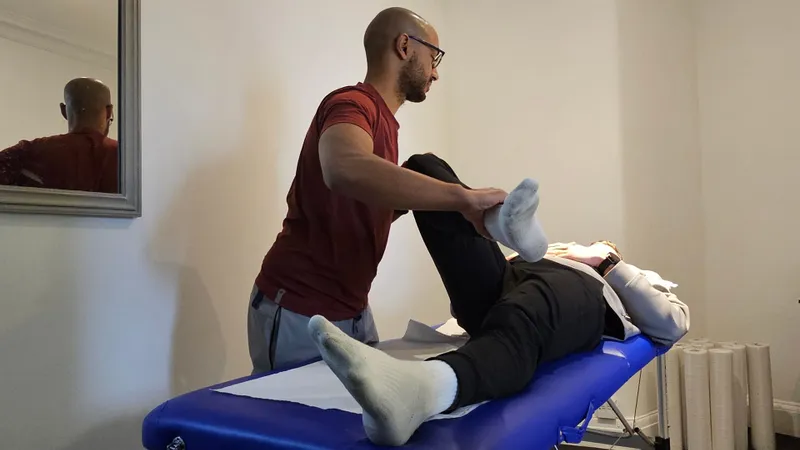
Price on enquirySports physiotherapy is the core treatment for almost every sports injury — accurate diagnosis, hands-on assessment and a graded loading plan, with readiness judged against criteria-based return-to-play markers rather than how the injury feels.
See treatment detail →Physiotherapy
Price on enquiryGeneral physiotherapy addresses the strength, mobility and control deficits up the kinetic chain that contribute to injury, and supports recovery where symptoms overlap with everyday activity rather than sport alone.
See treatment detail →FAQ
Common
questions
Should I rest a sports injury or keep moving?
For acute soft-tissue injuries, NHS advice is to protect, rest, ice, compress and elevate for the first few days, avoiding heat, alcohol and massage. After that, complete rest is rarely right. Modified activity that loads the tissue safely usually supports recovery better and preserves fitness. Your physiotherapist will tell you what to do, modify or pause.
How long until I can return to my sport?
It depends on the injury. Mild strains and overuse problems often allow modified training within a week and fuller return over several weeks; ligament and tendon injuries typically need longer phases of progressive loading. We set an indicative timeline at your first session and update it at each reassessment, based on objective markers rather than guesswork.
How do you decide when I am ready to return to play?
We use criteria-based return-to-play, in line with the BJSM 2016 Bern consensus, rather than discharging on how it feels. That means restored strength, good limb symmetry and movement control, and the ability to handle sport-specific demands — sprinting, cutting, jumping or single-leg load — without symptoms. Skipping these stages drives re-injury.
When should I seek urgent help for a sports injury?
Seek urgent help if the joint looks deformed, you heard a crack, you have numbness or tingling, or the skin below the injury is cold or discoloured — call 999 for these. Contact NHS 111 if pain, swelling or bruising is severe, you cannot bear weight, or there is no improvement after a few days of self-care.
Related Concerns

Get Started
Ready to begin?
Book today.
Kaizen Physiotherapy & Performance • 111 Charing Cross Road, Tottenham Court Road, London WC2H 0DT
BookAppointments typically available within 1–2 weeks