Low Back Pain & Sciatica — Physiotherapy in London
Most low back pain and sciatica is non-specific and recovers well with physiotherapy, exercise and education. Our Chartered, HCPC-registered physiotherapists provide NICE-aligned care across four London clinics — without routine imaging, opioids or prolonged bed rest. Self-referral; no GP letter needed.
Book Consultation
What you're seeing
The concern
Why it happens
What drives it
- Sustained postural loading — long desk hours, commuting or repetitive manual work
- Sudden mechanical overload — lifting beyond current capacity or abrupt twisting under load
- Irritation or compression of a lumbar nerve root, the usual driver of true sciatica
- Deconditioning — reduced strength and movement after time off, illness or surgery
- Pregnancy and the post-natal period, which alter how the lumbar spine and pelvis are loaded
- Stress, poor sleep and low mood — well-evidenced amplifiers of pain perception
- Recurrent flares from a long-standing weakness or an unhelpful movement pattern
Treatment approach
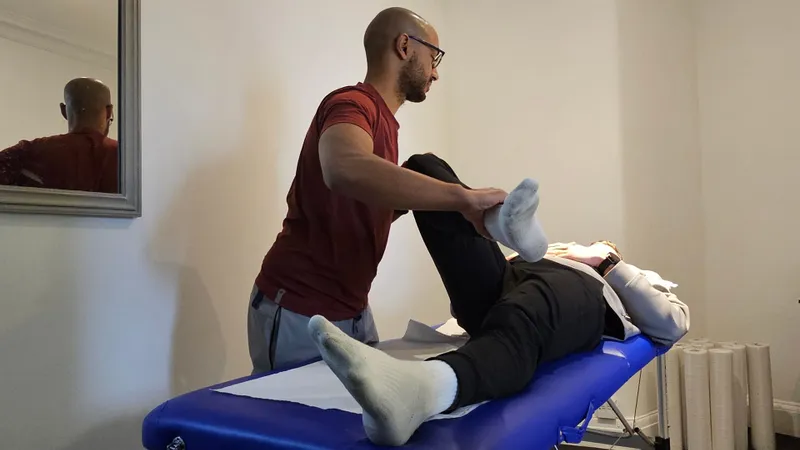
How David treats it
Physiotherapy
Price on enquiryCombined assessment, education, manual therapy and progressive exercise is the NICE NG59 first-line treatment for both non-specific low back pain and sciatica.
See treatment detail →Sports Physiotherapy
Price on enquiryGraded, individualised exercise rehabilitation rebuilds strength and load tolerance in the lumbar spine and supports a confident return to work and sport — the strongest evidence-based defence against recurrence and a core element of NICE NG59 care.
See treatment detail →Reformer Pilates
Price on enquiryReformer Pilates with our Chartered physiotherapists rebuilds controlled trunk and lower-limb strength under supported load — an exercise-based way to maintain movement and reduce recurrence, consistent with the NICE NG59 emphasis on exercise.
See treatment detail →FAQ
Common
questions
When should I go to A&E for back pain or sciatica?
Go to A&E immediately if you develop loss of bladder or bowel control, numbness around the saddle or genital area, or progressive weakness in both legs. These can signal cauda equina syndrome — a rare emergency needing urgent imaging and surgery within hours. Also seek urgent care after significant trauma. Physiotherapy is not the first step in these cases.
Do I need an MRI scan for my back pain or sciatica?
Usually not. NICE NG59 advises against routine imaging for non-specific low back pain and sciatica, because it rarely changes treatment and often shows incidental findings — disc bulges or mild degeneration — that are common in pain-free people. We reserve imaging for genuine red flags or symptoms that fail to improve and suggest a specific cause needing investigation.
Should I rest or stay active when my back or leg hurts?
Stay as active as your pain reasonably allows. NICE advises against prolonged bed rest, which slows recovery and raises the risk of persistent problems. Walking, gentle movement and keeping to your normal routine where possible are recommended even during an acute flare. Your physiotherapist will guide what to modify and what you can safely keep doing.
How long does sciatica take to get better?
Most sciatica improves over several weeks, and the majority resolve without surgery. With physiotherapy, an acute first episode of low back pain often settles within a handful of sessions, while recurrent or longer-standing pain responds more gradually over a longer course of structured exercise. Your physiotherapist will give you an honest, individual projection at your first appointment.
Related Concerns
Get Started
Ready to begin?
Book today.
Kaizen Physiotherapy & Performance • 111 Charing Cross Road, Tottenham Court Road, London WC2H 0DT
BookAppointments typically available within 1–2 weeks